Using Amazon Kindle as a Map Repository

Here are few simple ways to make your Amazon Kindle more useful by using it as a Map Repository during your travel. A more convenient way that carrying printed maps on your bag  :) This assumes that your Kindle cannot connect to 3G network and no Wi-Fi signal is around to make google map accessible.


What do you need ?
  1. Amazon Kindle.
  2. PDF Printer - to convert the google map to PDF format. You can try usiong PrimoPDF , it is free!
  3. A compass, in case you are not sure where north, east, south, west is :)
  4. An eyeglass! If you have a poor eyesight.
Steps :
  1. Go to Google Map.
  2. Search for the direction. 
  3. Click Print.
  4. Configure the Print Out
    • Select Text Only, if you want the instruction in text format only.
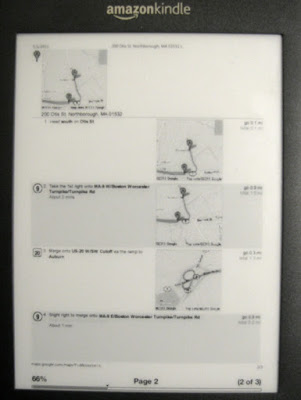
    • Select Maps, if you want to include small maps in every driving intructions
    • Select Street View, if you want to have an idea how the location looks like. The image maybe outdated.
    • Check the "Include large map" to have the map shown in the first page.
  5. Print the Map to PDF.
  6. Save the PDF file in your Amazon Kindle.
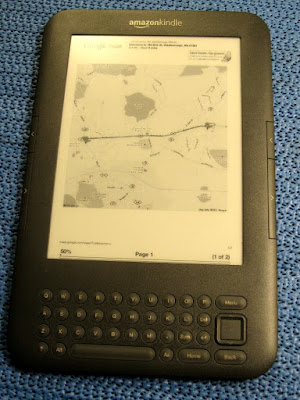
Kindle displaying the map
Kindle showing the direction with map.
It is not easy when you are new to a place, especially if it is outside your own country. You may not know someone, you are unfamiliar with the place, your mobile phone is useless and all anxieties that comes with it. Getting around the area would have been easier if public transport is as available as jeepneys back in the Philippines, unluckily in our case , we have to drive our way around. Cool! we got a car, only if we know how to go to places. Well, GPS can solve it, unfortunately for us, we don't have it either. The solution, plan your trips and use google map!

Comments

Red Font said…
Nice post.

Popular posts from this blog

Getting Started with Stateless : A Lightweight Workflow Library Alternative for .NET

Image Credit: https://www.pioneerrx.com A year ago, I was looking for a simple workflow manager for a project I was working. Its a medium sized application that involves tracking the state of assets in the system. Back in 2008, Microsoft (MS) introduced new technologies along with the release of Visual Studio 2008: Windows Presentation Foundation (WPF), Windows Communication Foundation (WCF), and  Windows Workflow Foundation (WF). Having worked in a company utilizing mostly MS products for development, my first option was to go with WF. After doing some time reading and studying the library, I paused and decided it was too complex for my requirement. Using WF would be an overkill and the fact that it has, a rather, steep learning curve, there has to be another option. My mind toyed with the idea of developing a simple workflow library myself. It would be a learning experience but it might end up consuming a lot of time. Why reinvent the wheel? So I started querying the ...

Hiding Unwanted Python Folders and Files in Visual Studio Code

Visual Studio Code is a universal editor and pretty good at it. However, the explorer view maybe cluttered with the automatically generated folders and files confusing developers. Python is no different. Below are example files and folders generated by Python. The __pycache__ folder and *.pyc files  are totally unnecessary to the developer. To hide these files from the explorer view, we need to edit the settings.json for VSCode. Add the folder and the files as shown below: Copy and paste the lines below : "**/*.pyc" : { "when" : "$(basename).py" }, "**/__pycache__" : true

The Story Behind the Name C#

I remember one time in an exam for employment , the first question was - who is the father of C#? I have been working with the language but never did I ask myself who actually started the language ( of course Mirosoft was the brainchild , right? ) . After a googling expedition I found out who was the culprit - Microsofts Anders Hejlsberg . I was not interested why it was called C# then , but opening my VS2008 today , I stumbled on one of the articles being shown at the VS2008 opening page - "Computer World: The A-Z of Programming : C#". Its an interview with Anders discussing the history and beyond of C# . Heres the cool part , the name for C# prior to its release was actually COOL (C like Object Oriented Language) . Below are some lines taken from the interview: Why was the language originally named Cool, and what promoted the change to C#? The code name was Cool, which stood for ‘C like Object Oriented Language’. We kind of liked that name: all of our files were called .coo...